

Home Counties Meeting at Cobham
Saturday 28th February 2026
This was the fourth Home Counties Meeting held in Cobham and organised by Joan Bingley. It was held again in the main hall of Church Gate House Centre adjacent to St Andrew’s Church in Cobham, Surrey. The hall has a kitchen where we could help ourselves to tea, coffee and biscuits. The day started with refreshments, followed by three talks, a break for lunch, and an afternoon of exhibits and gossip.
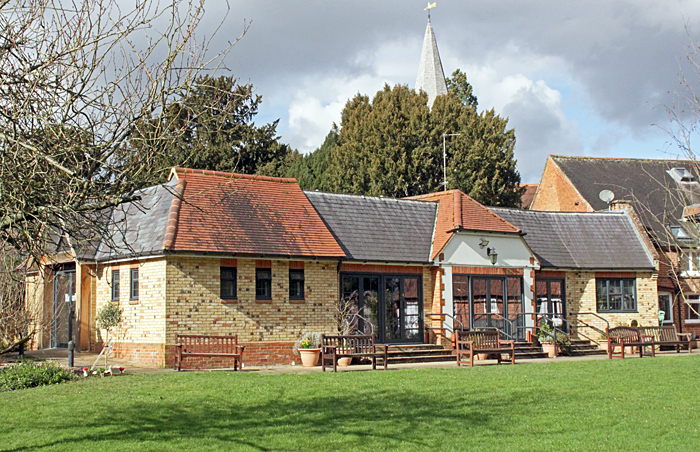 Church Gate House Centre
Talks
Phil Greaves “Colour, Contrast and Complexity: the Jamin-Lebedeff Interference Microscope”
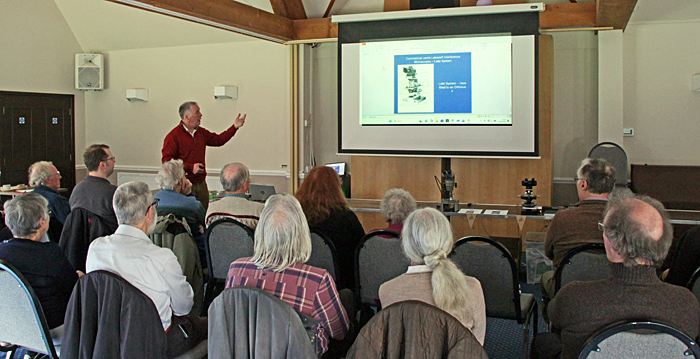 Phil Greaves’ presentation
Phil took us through a range of techniques for adding contrast and colour to the view through a microscope, including the relatively simple phase contrast and dark-ground. Then the Smith interference contrast system used by Baker, Vickers and Leitz, and the widespread Nomarski differential contrast system that adds colour and appears to show 3-dimensional structures. Phil has long wanted a more complex system using Jamin-Lebedeff Interference, which incorporates Savart plates in the condenser and objectives. The objectives are non-removable and are matched to the condenser at the factory. Phil recently found a fully-equipped Leitz microscope, and is now learning how to use it. Zeiss and American Optical also produced Jamin-Lebedeff systems.
You can see the slides from Phil’s presentation here:
Click the arrows to move through the slides. Click the symbol at bottom right for a larger version.
Graham Matthews “Recent work on photographing the QMC slide collections”
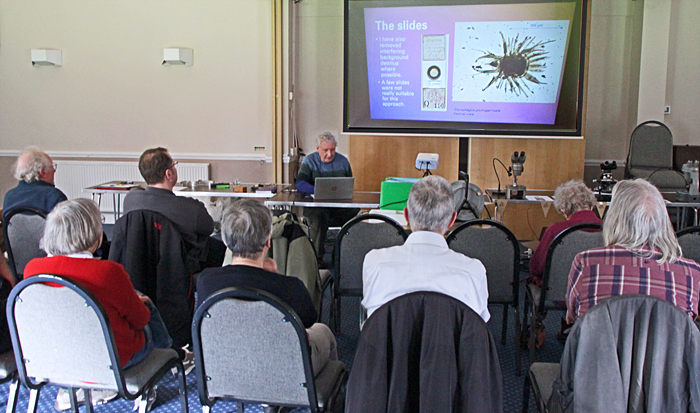 Graham Matthews’ presentation
The Quekett has a collection of over 20,000 slides that are stored in a locked room in an area of the Natural History Museum that is not open to the public. For several years, we have been trying to find a way to make the collection accessible, and some of the slides have been photographed and some of the labels have been transcribed. Trial databases have been produced, but we are still a long way from having a complete database with an image of each slide.
Graham has recently been photographing the slides of mites in a collection that was entrusted to the Club by A. D. Michaels. There are about 100 slides, and Graham has photographed the whole slides, and the specimens from above and below. He has also photographed some of the slides in the E. D. Evens collection.
We really need an expert to help set up a database.
You can see the slides from Graham’s presentation here:
Click the arrows to move through the slides. Click the symbol at bottom right for a larger version.
One of the images in Graham’s presentation showed an old slide with discoloured mountant and his photomicrograph with the background removed. It was not done by flooding with white, but by subtracting an image of the background in PaintShop Pro. He is going to explain how it is done.
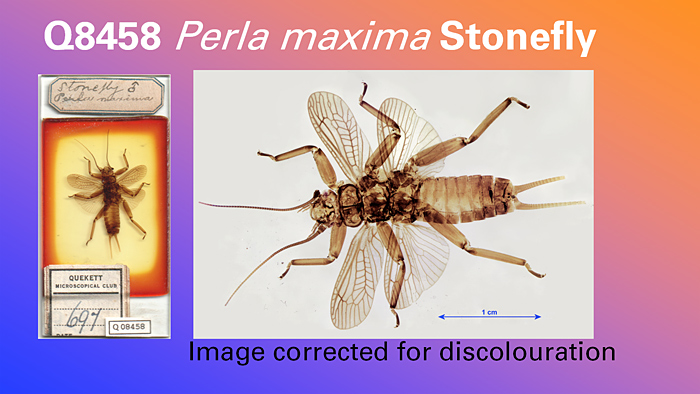 Background subtraction
Pam Hamer “Thin rock sections from Birkbeck College”
At the Geologists’ Association Festival of Geology in November 2025, Pam learned that Birkbeck College had a collection of about 80 slides of thin rock sections that they no longer required. Pam offered to take them all for the Quekett, and now needs to decide what to do with them. Some will probably be added to the Club’s slide collection, some to produce new slide sets that members can borrow, and the remainder to be sold at the Club’s next auction. Pam brought the slides so that we could examine them during the gossip in the afternoon.
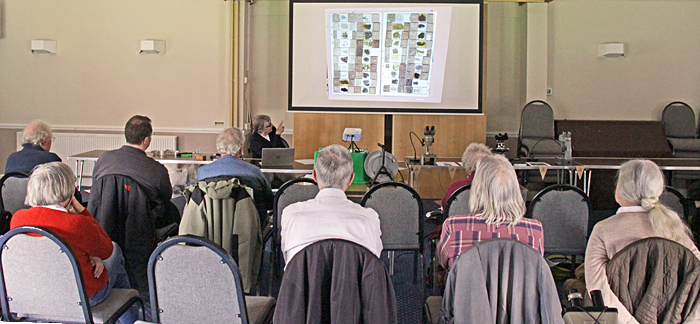 Pam Hamer’s presentation
Lunch
For lunch, members could either bring their own or opt for fish and chips from a local shop, kindly ordered and collected by Joan Bingley.
 Lunch
Lunch
Gossip
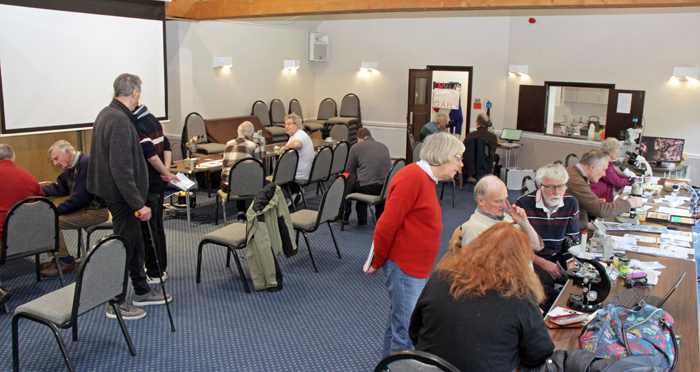 Exhibits for the afternoon gossip
Mark Berry brought two microscopes, a black Zeiss compound with a grey trinocular head, and a Charles Perry stereo His specimens included bryozoans and other organisms from rock pools, and moss squeezes.
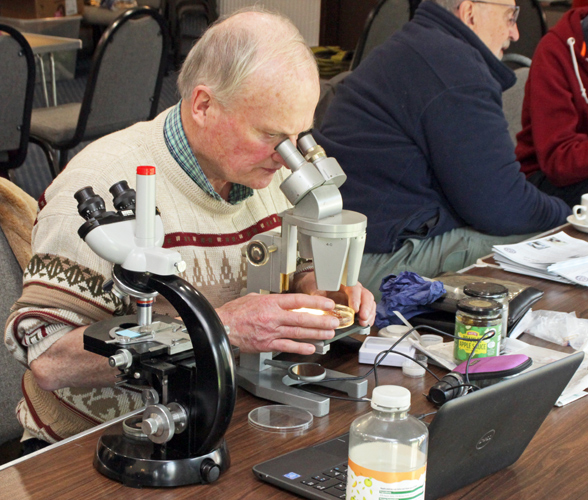 Mark Berry
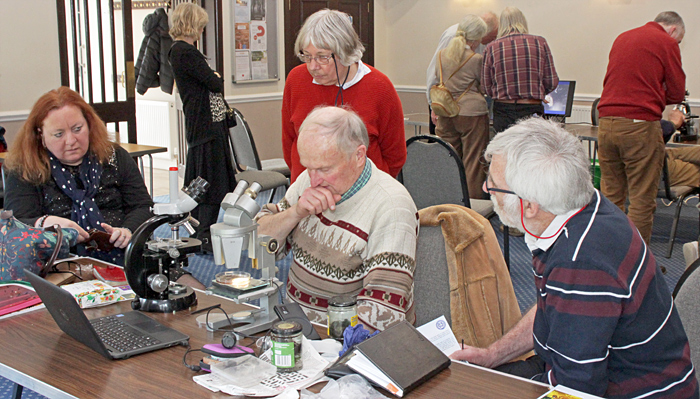 Mary Berry, Mark Berry, Rita Batchelor and Trevor Batchelor
Joan Bingley focused on forams and the Postal Microscopical Society.
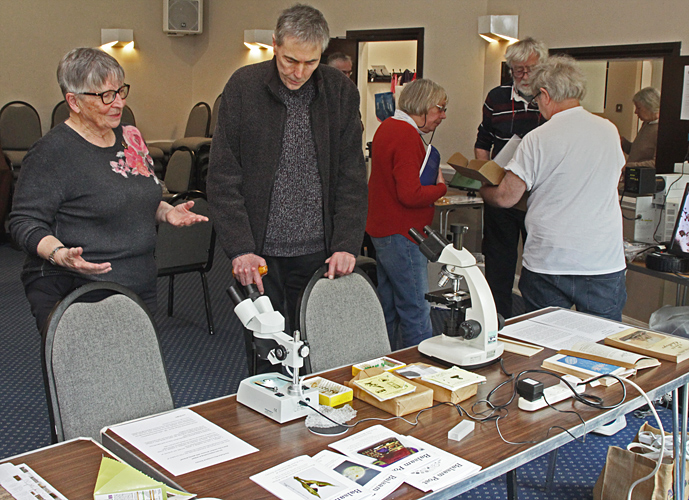 Joan Bingley and Tim Fullick
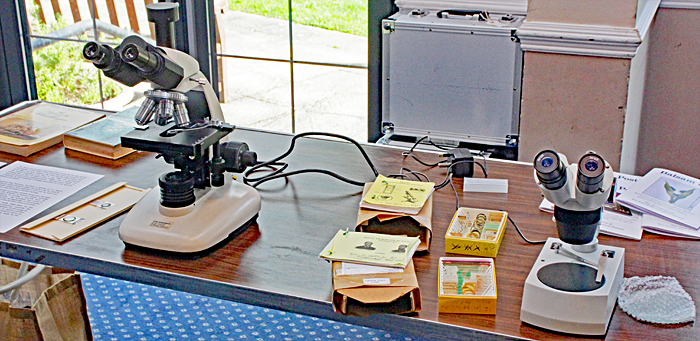 Joan Bingley’s exhibit
To remind us of the upcoming Zoom gossip meeting on forams, Joan brought two out-of-print books, The Open Sea: The World of Plankton (Collins New Naturalist Library, Book 34) by Alister Hardy and The Voyage of the Challenger by Eric Linklater. It is 150 years since HMS Challenger returned to England after its four-year voyage with specimens that included lots of forams. She brought a Brunel compound microscope and a small stereo so that we could examine two slides by Brian Darnton of forams from the later voyages of HMS Discovery and the Lord Brandon.
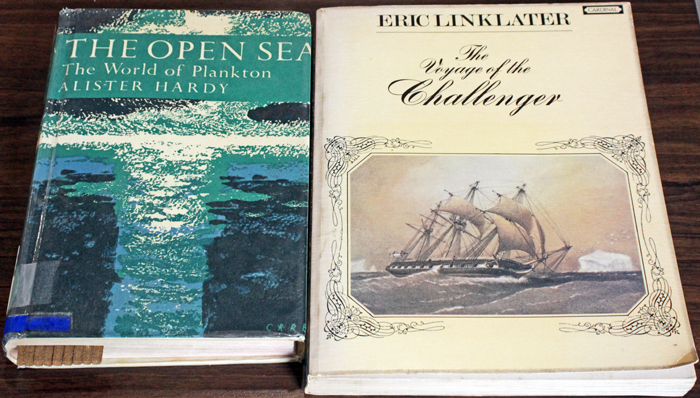 Books with information on forams
To promote the Postal Microscopical Society, Joan brought two of the boxes of slides that they circulate to members, and several copies of their newsletter, Balsam Post.
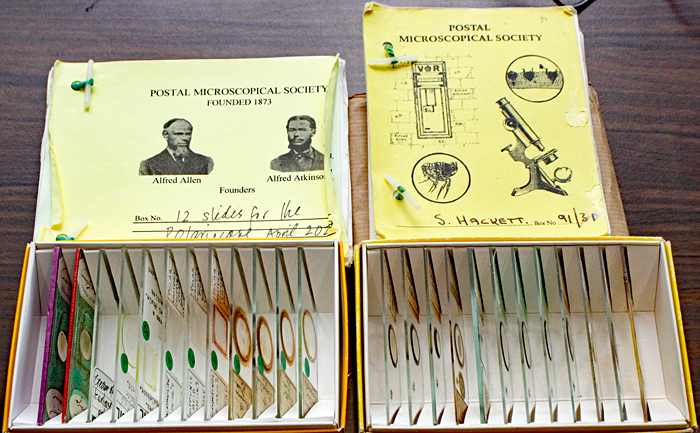 PMS slide boxes and notebooks
Stephen Durr used his trinocular Leitz Dialux 20 EB (equipped for bright field and phase contrast) to show images of cyanobacteria (blue-green algae). He has been studying how they move up and down the water column.
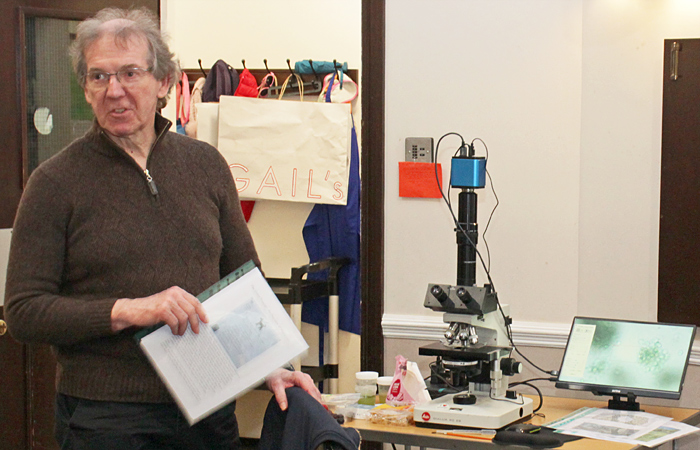 Stephen Durr
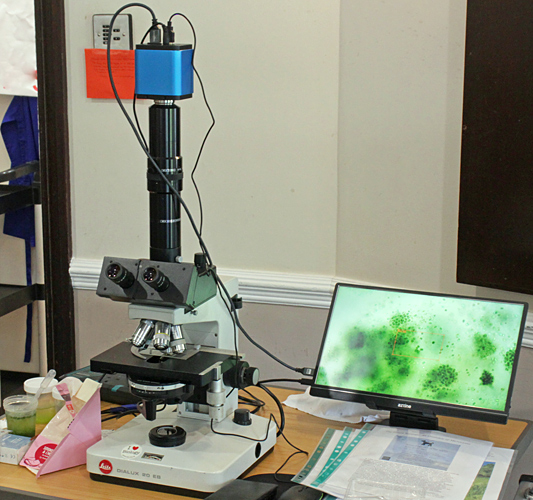 Stephen Durr’s exhibit
Tim Fullick brought a Carl Zeiss Jena IVa microscope with its fitted wooden box. Charles Darwin brought one of this model in 1881 for his son Francis.
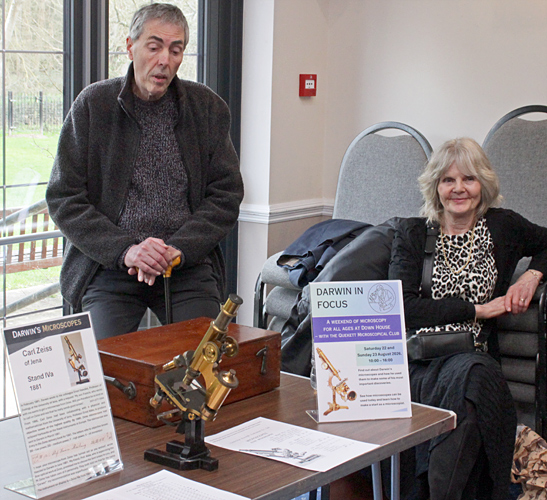 Tim and Toni Fullick
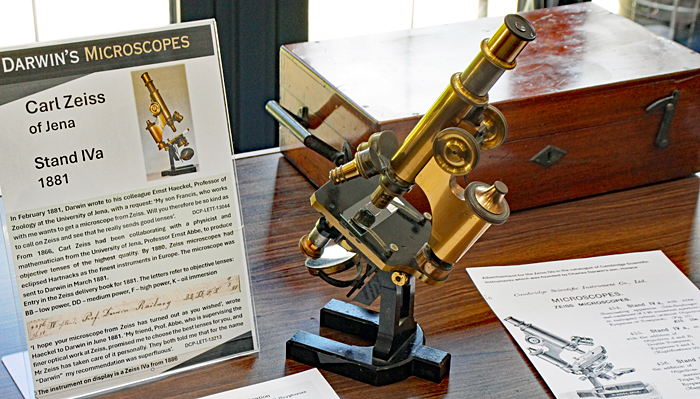 Carl Zeiss Jena IVa
Tim also reminded us about the Microscopy Weekend at Down House on Saturday 22nd and Sunday 23rd August 2026, where he will show other antique microscopes and the Quekett will have exhibits indoors and in the greenhouse.
Phil Greaves brought a black Leitz microscope equipped for Jamin-Lebedeff interference contrast (the subject of his presentation in the morning), and showed us how to adjust the controls to change the colours.
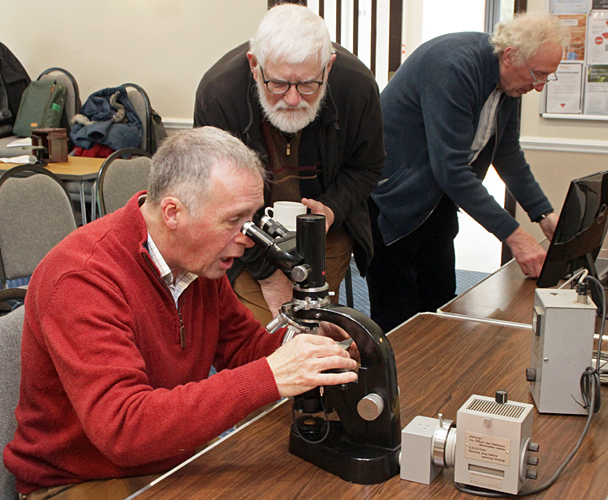 Phil Greaves (seated), Desmond Squire and Grenham Ireland
Pam Hamer brought the thin rock section slides from Birkbeck College that were the subject of her presentation in the morning, with a Vickers polarising microscope so that we could view them. She also brought copies of the free Quekett leaflets, including the latest one: Things to look at with microscopes: Exploring polarised light.
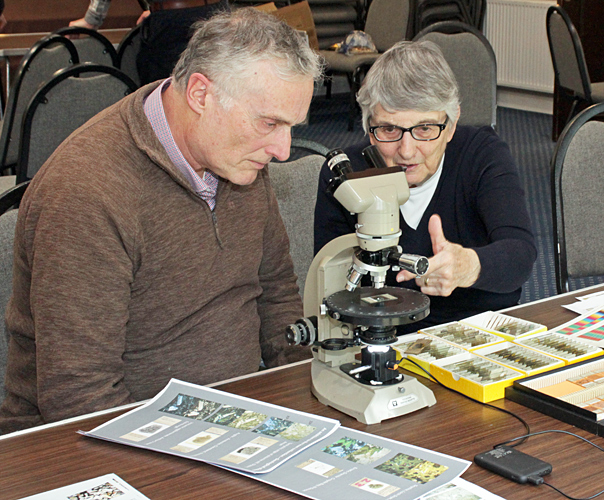 Laurence Peacock and Pam Hamer
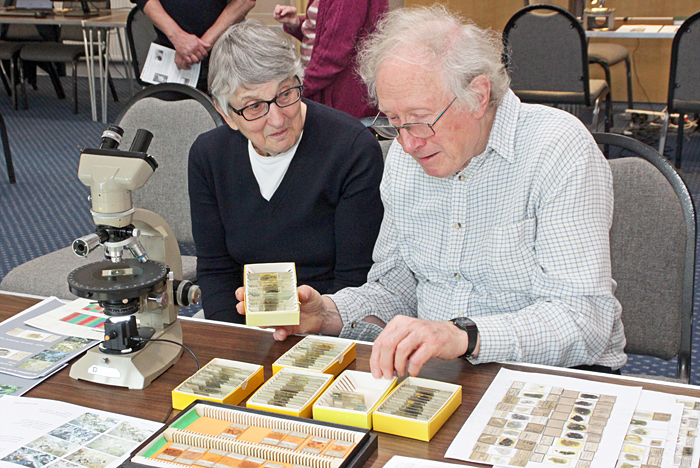 Pam Hamer and Grenham Ireland
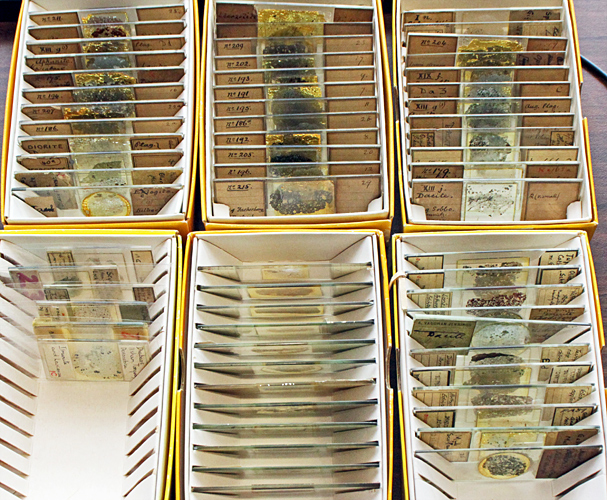 Rock section slides
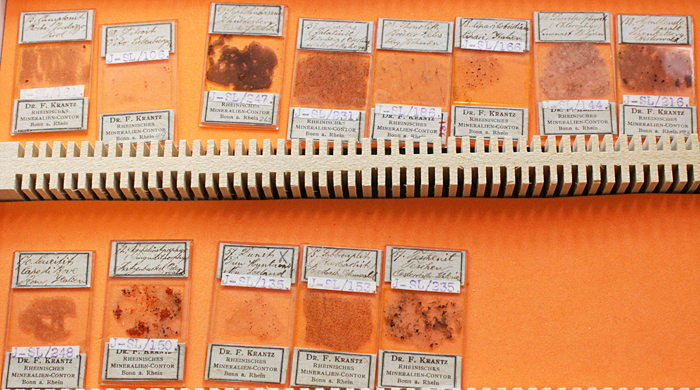 Rock section slides by Dr F. Krantz
Grenham Ireland showed stills and videos of ctenophores (comb jellies) and their digenean trematode parasites. He would like to find out the primary and secondary hosts of the parasites.
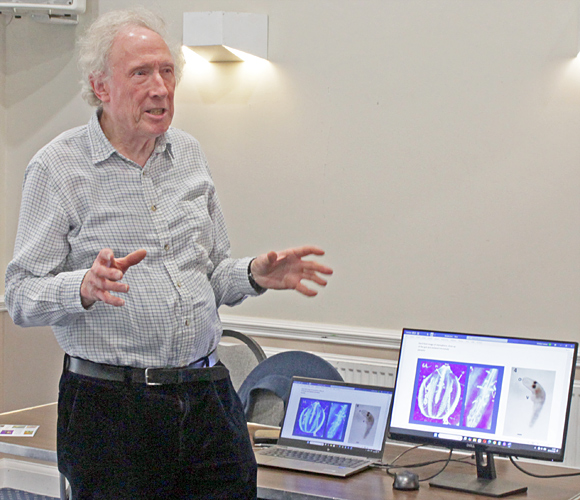 Grenham Ireland
Robert Ratford needed a trolley to bring in his latest acquisition, a trinocular Olympus BX51 metallurgical microscope with plan fluorite objectives, equipped for polarisation and DIC. He showed images of a £1 coin and the engravings on a metal ruler on a monitor.
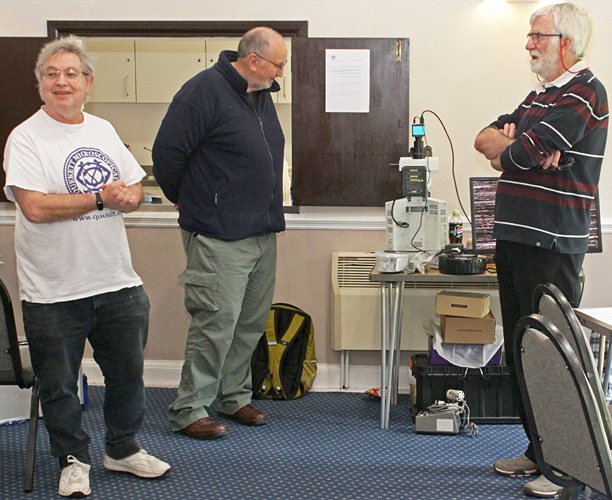 Robert Ratford (left), Graham Carey and Trevor Batchelor
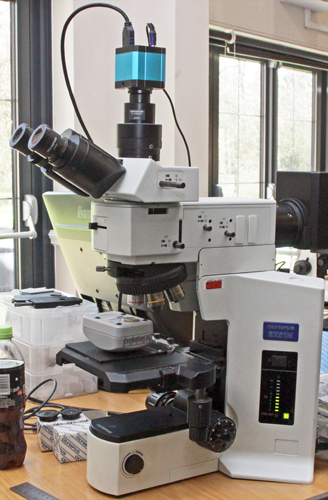 Trinocular Olympus BX51M metallurgical microscope
Nigel Williams showed three slides by Klaus Kemp, a peacock made from diatoms and butterfly scales, a circular arrangement of Oamaru diatoms, and an arrangement of 49 butterfly scales. For admiring them, he provided Olympus SZ and Bausch & Lomb SZ3 stereo microscopes with transmitted light bases, and a Wild compound microscope.
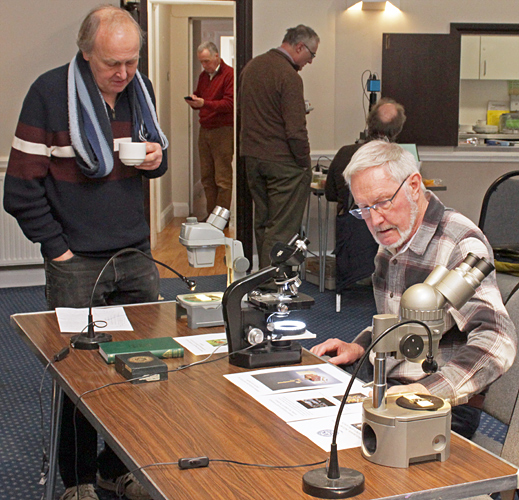 Tim Diss and Nigel Williams (right)
Alan Wood can’t remember how long he has owned this Spencer Dissecting Microscope No. 82 from the 1920s, but it has been sitting in a cupboard for about 25 years since he bought a stereo microscope. He no longer needs the Spencer, so it will soon be on its way to a young member of the Anglian Microscopy Group.
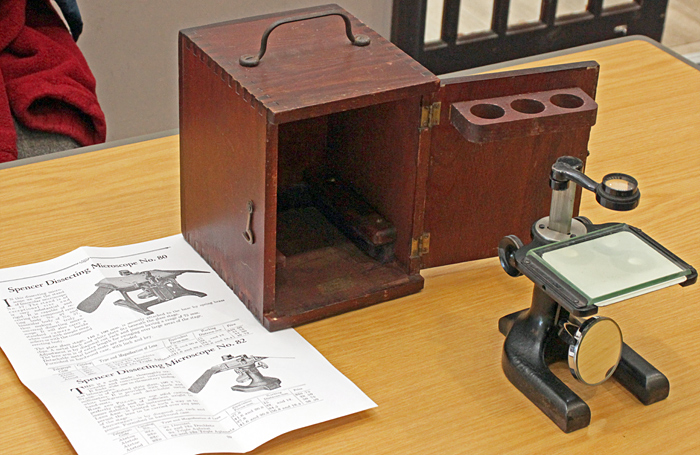 Spencer Dissecting Microscope No. 82
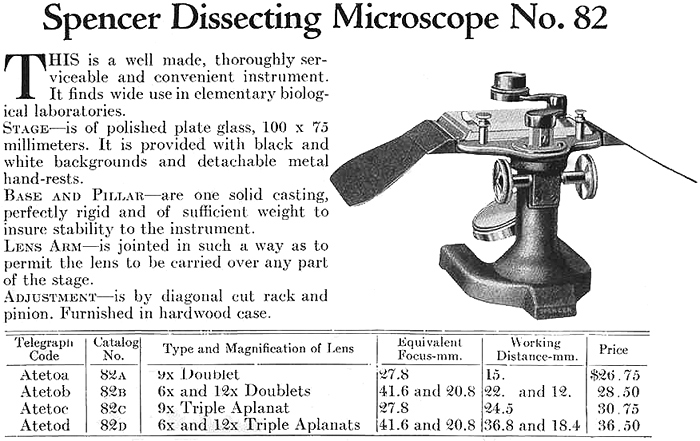 Spencer Dissecting Microscope No. 82
Acknowledgements
Our thanks to Joan Bingley for organising the event, providing the refreshments and collecting the fish and chips, and to all those who got out and put away the tables and chairs.
Report and photographs by Alan Wood