

Workshop on Cladocera (waterfleas)
Saturday 13th June 2026
Robert Ratford opened the workshop in the Angela Marmont Centre in the Natural History Museum with an explanation of the derivation of the name “Daphnia” and of related organisms such as “Cyclops” and “Polyphemus”. Robert provided everyone with a labelled anatomical drawing of waterfleas. Members brought various aids to identifying waterfleas, such as A Key to the British Species of Freshwater Cladocera by D. J. Scourfield & J. P. Harding
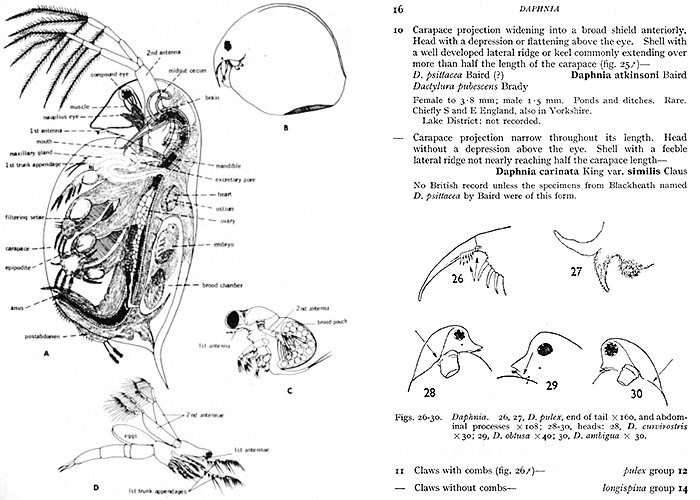 Anatomical drawing and key
The meeting was billed as a workshop, but quickly turned into a pond-dipping session. There are two ponds in the Museum’s Nature Discovery Garden, a large one at ground level and a smaller raised one. There are no designated dipping areas, but the water comes right up to the walls in various places, making it to easy to use nets. We used to visit the ponds each year for the Quekett’s Young Scientists’ Day, but the last one was in 2015.
We were pleased to meet Karen Helke, who is in charge of the pond in the garden of the Museum. She joined us for pond-dipping and for examining the catch.
The ponds are designed to showcase native plant species, in the water and on the banks. On the surface, there are water-lilies and pennywort, and a lot of blanket weed (filamentous algae). We saw a few dragonflies and damsel flies.
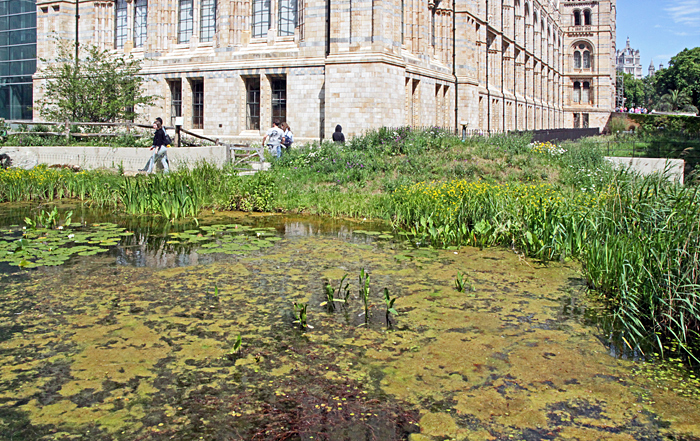 Main pond in the Nature Discovery Garden
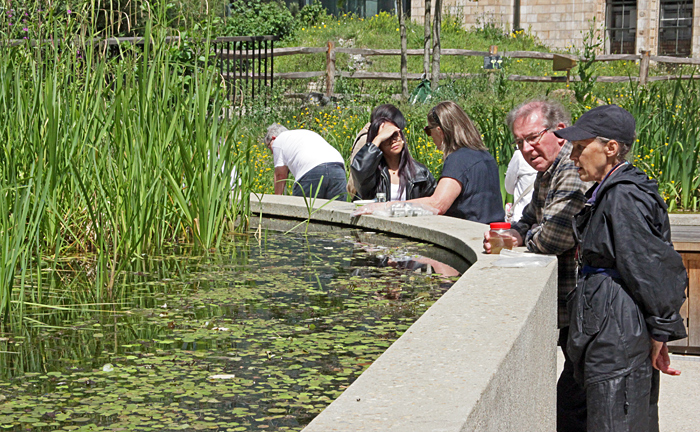 Raised pond in the Nature Discovery Garden
Robert Ratford used a swimming-pool cleaner with a telescopic handle to collect samples from the bottom and from the water column. The cleaner runs off batteries, and contains a removable net.
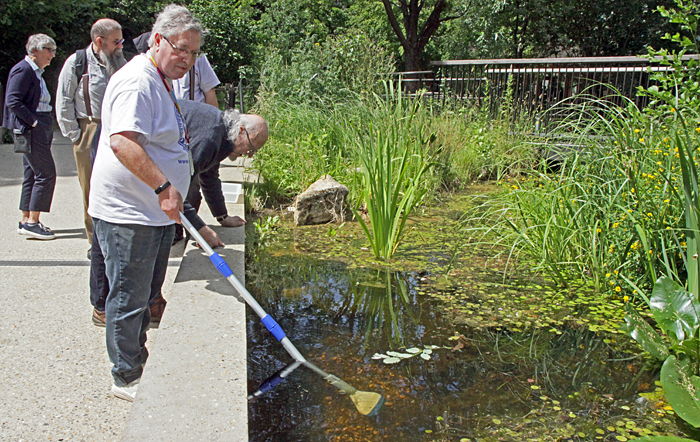 Collecting from the bottom of the pond
John Gregory used a trawl net to collect from the water column.
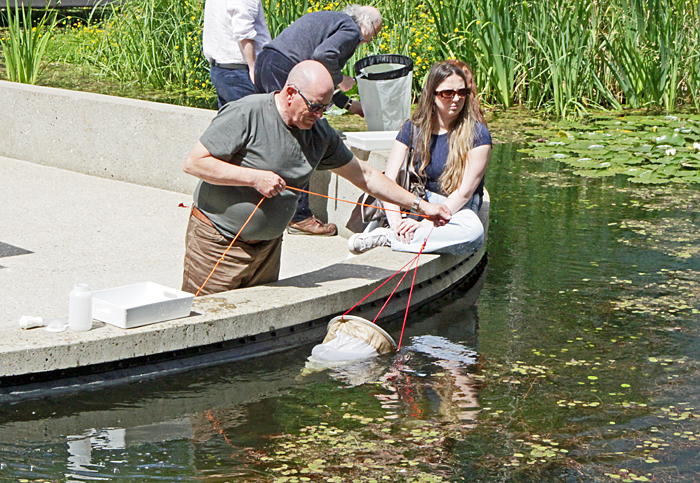 Collecting from the water column
Other members and some young visitors used more traditional pond nets.
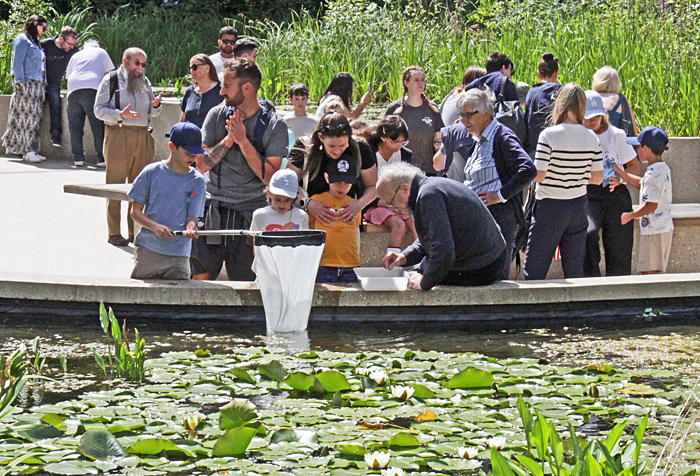 Collecting with a pond net
Blanket weed is easy to collect, no net required, and lots of microscopic creatures live within it.
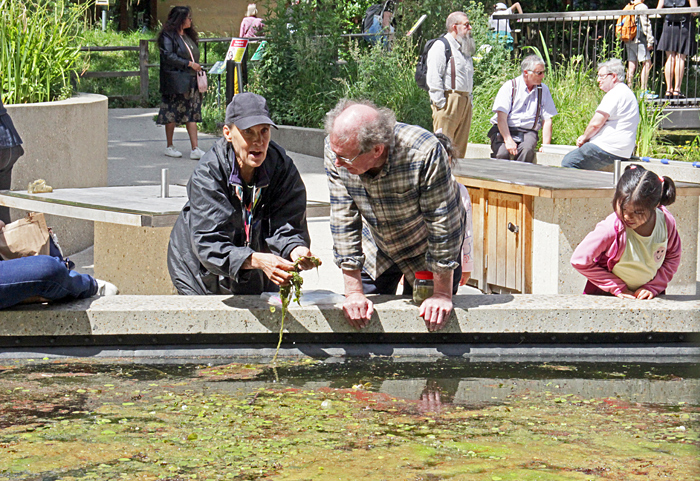 Karen Helke collecting blanket weed
There were several families in the Garden, and adults and children were keen to see what we were doing and what we found.
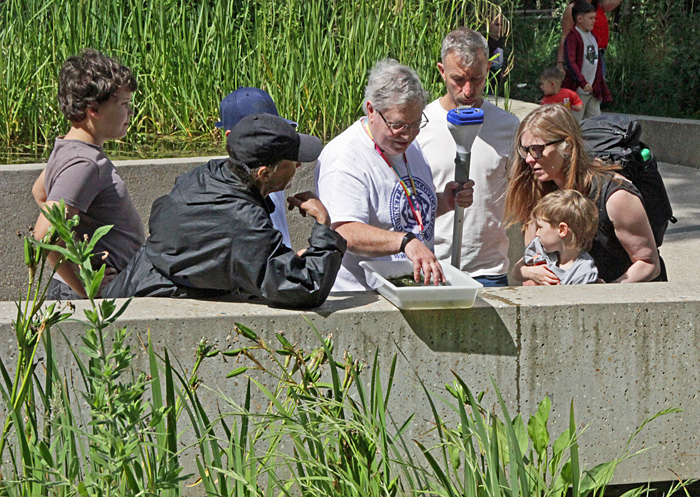 Robert Ratford with visiting families
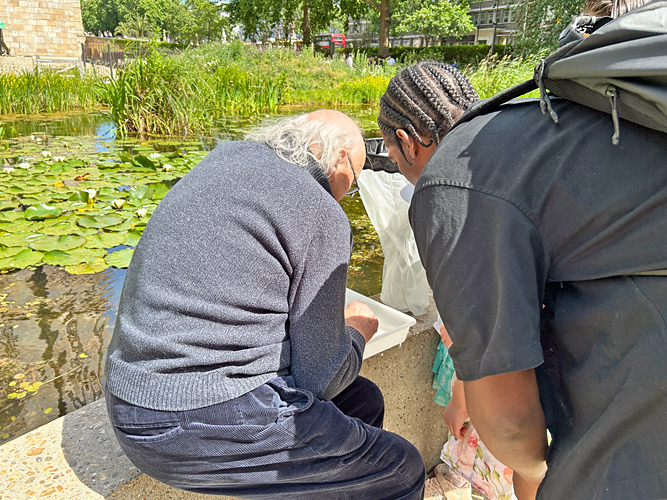 David Lewis with a visitor [by Pam Hamer]
Our catches included a smooth newt and a few of its tadpoles. These were carefully returned to the pond.
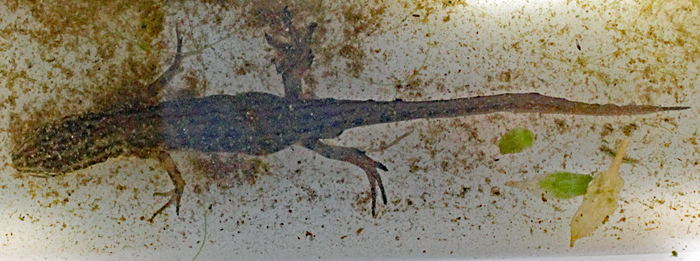 Smooth newt
We took two trays of specimens back into the Centre for a closer look under the microscopes.
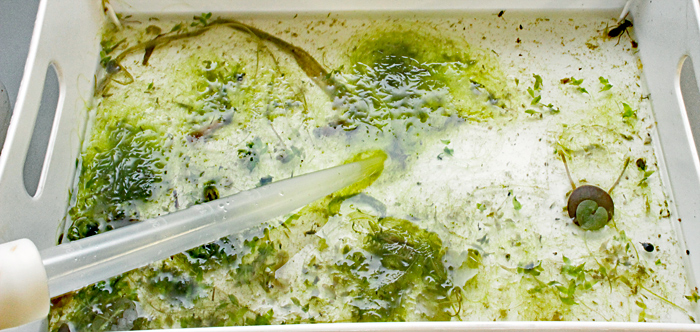 Sample from the ponds
Robert had brought some samples from other locations, in case the weather prevented sampling on the day.
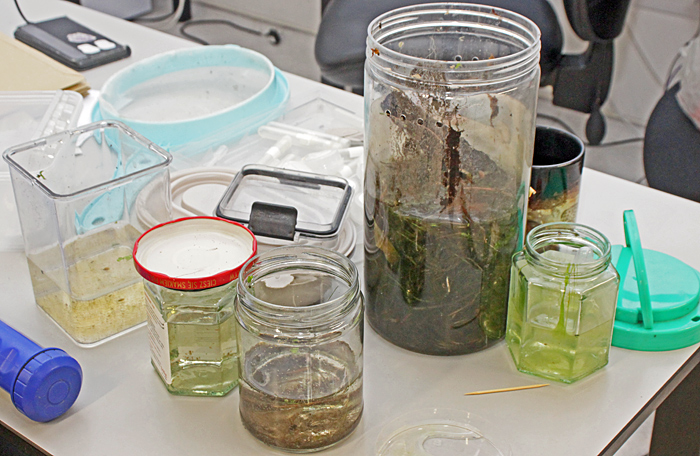 Other samples
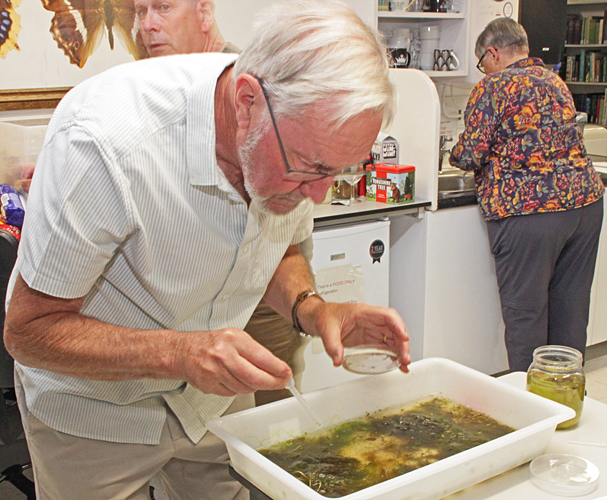 Nigel Williams
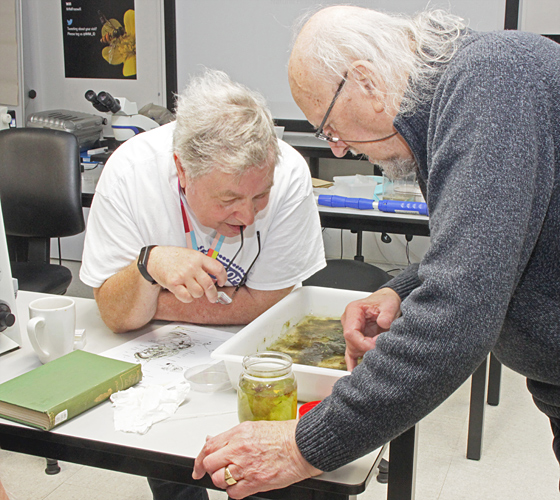 Robert Ratford and David Lewis
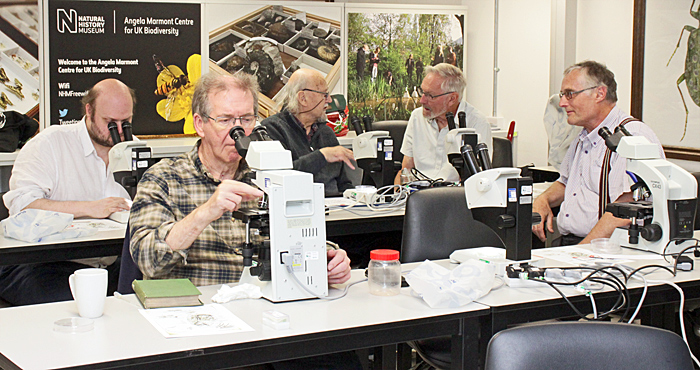 Members and microscopes
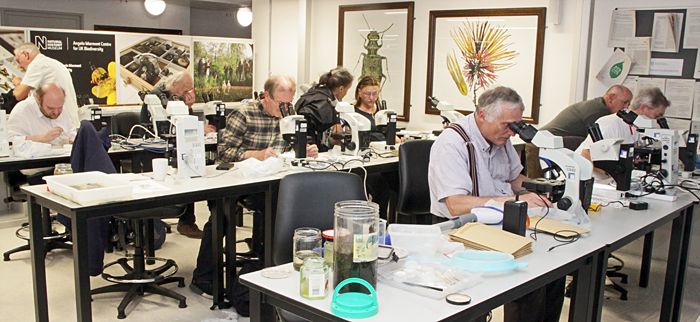 Members and microscopes
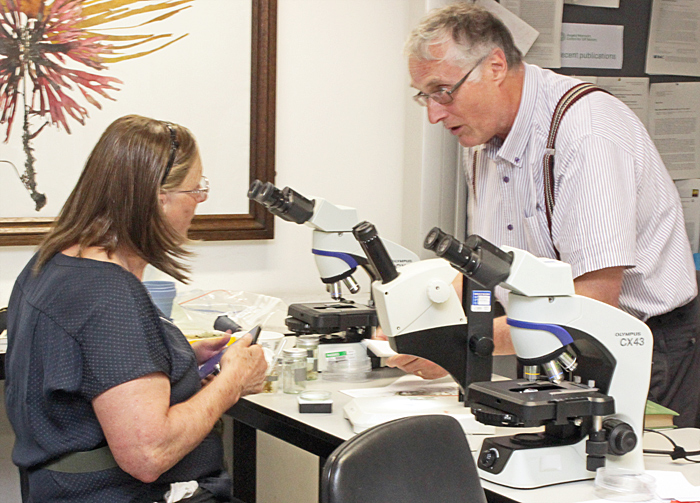 Jacky McPherson and Laurence Peacock
The Centre’s microscopes do not have trinocular heads, so to take photos Karen used a smartphone and Rhodri used a tablet.
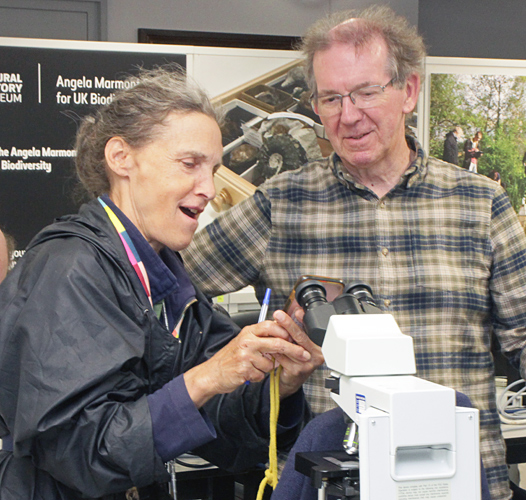 Karen Helke and Steve Durr
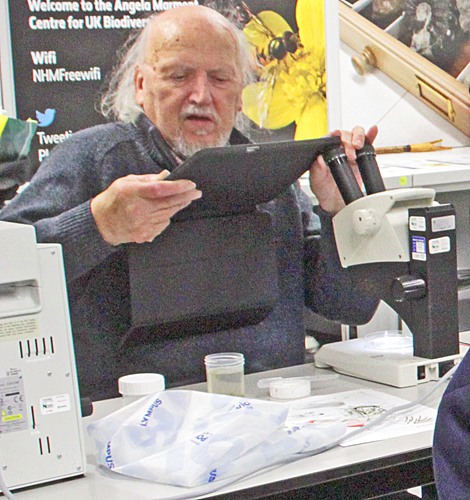 David Lewis
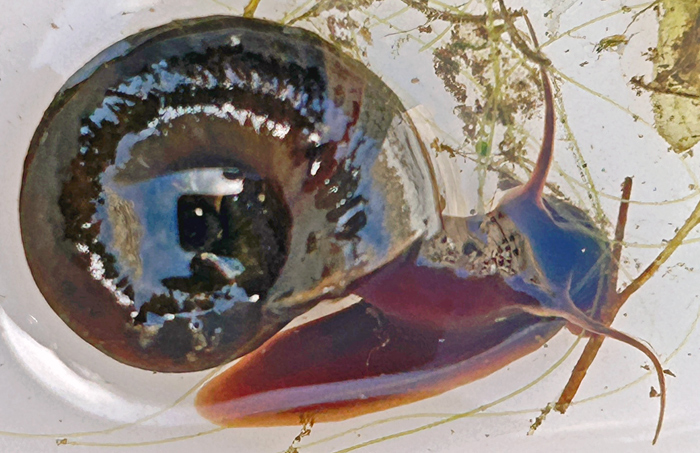 Ramshorn snail [by Pam Hamer]
We found a few waterfleas in the samples, some with eggs. We also found a few copepods, a lot of mayfly nymphs, a dragonfly larva, phantom midge larvae, water boatmen, water beetles, water mites, planarians, Aeolosoma worms, leeches, ramshorn snails and pond snails. At the end of the meeting, we returned all of the specimens to the ponds.
Thanks to the chance meeting with Karen Helke, we will be exploring ways to expand our microscopy outreach programme to include the Nature Discovery Garden.
Acknowledgements
Our thanks to the Natural History Museum for allowing us to use the Angela Marmont Centre and their Olympus CX41 and CX43 compound microscopes and Leica EZ4 stereo microscopes.
Report and most photographs by Alan Wood