

Gossip meeting “Stained sections”
Tuesday 13th May 2025
This gossip meeting was held in the Angela Marmont Centre in the Natural History Museum in London. The participants gave brief introductions to the slides that they had brought, and then we spent the afternoon discussing them and examining them under the Museum’s Leica EZ4 stereo and Leica DM750 compound microscopes.
 Angela Marmont Centre
Nigel Ashby brought two trays of old and recent slides from makers including Eric Marson (NBS), Mike Smith, F. Weait, John Wells (Biosil), T. Gerrard, Griffin Biological and Watson.
 Nigel Ashby
 Nigel Ashby’s slides
 Transverse section of Pinus sylvestris by F. Weait, stained with safranin [Photo by Lisa Ashby]
Joan Bingley brought a slide of a whole leaf of Chaenomeles sp. stained with safranin by Eric Marson (NBS). She also brought a copy of Balsam Post with Eric’s article “Stained Whole Mounts of Leaves” (Part 46, January 2000, pp. 20–22).
 Joan Bingley
 Joan Bingley’s slide
Phil Greaves showed an unusual field microscope, the Heimdal by Reichert. The legs, arm and stage fold so that the microscope can fit in a rectangular metal case, which in turn fits in a brown leather case. Phil also brought a type slide of forams, made by Eduard Thum and sold by Baker.
 Phil Greaves
 Phil Greaves’ exhibit – Heimdal field microscope
Graham Matthews showed a box of human histology slides that he had bought from Maurice Moss. The slides were originally labelled only with the names of the stains, but Graham has managed to identify most of the specimens with assistance from Jeffrey Silverman.
 Graham Matthews
 Graham Matthews’ slide set
 Graham Matthews’ slides
Jacky McPherson showed some brain sections in a variety of colours due to the stains that had been used. She also brought several pages of information that she had obtained from the Internet.
This gave rise to a discussion of the Human Tissue Act 2004, which specifies that cell deposits or tissue sections on microscope slides are relevant material. Professor Hope informed us that the Act is intended to apply to organisations such as museums, hospitals and laboratories, and that it does not impose restrictions on the possession, purchase or sale of slides by amateur microscopists.
 Jacky McPherson
 Jacky McPherson’s brain sections
Chris Thomas showed us some slides that he had made of caterpillars of the box moth (Cydalima perspectalis) and explained how he had prepared the specimens and mounted them. He had tried Quink ink as well as acid fuchsin.
 Chris Thomas
 Box moth caterpillars
Nigel Williams brought some slides made by Colin Kirk, including ovary of a cat, inflorescence of Scot’s pine (Pinus sylvestris), embryo and placenta of wood mouse (Apodemus sylvaticus) and body of a swallow (Hirundo sp.)
 Nigel Williams
 Nigel Williams’ slides
Alan Wood brought some slides that he had acquired at Club meetings since joining the Quekett in 2011, including ones made by Quekett members Eric Impey, Ernie Ives, Colin Kirk, Eric Marson (NBS), Mike Smith and John Wells (Biosil), some axolotl sections described as “probably by Robin Wacker”, and some commercial slides sold by Gerrard and Philip Harris. He also brought some histology slides from Lambeth Hospital that he bought from Clarkson’s in High Holborn in 1963 when he was looking for his first microscope. Alan had included some unusual specimens, including grasshopper, guppy, ostrich, potato fungal rot, slime mould and swan mussel.
 Alan Wood’s slides
 Stained sections of plants
 Stained sections of vertebrates
 Various stained sections
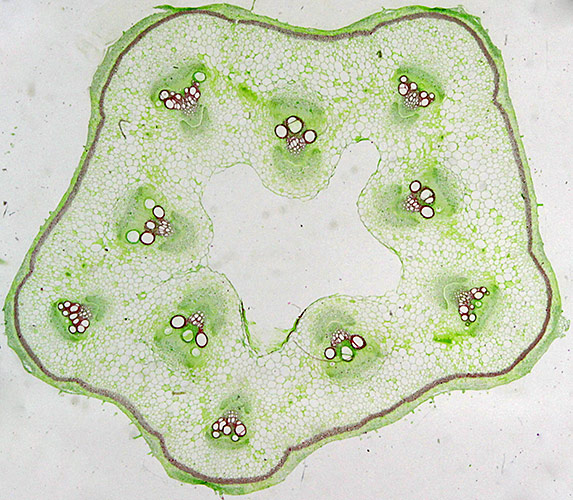 Sieve tubes in transverse section of stem of Cucurbita
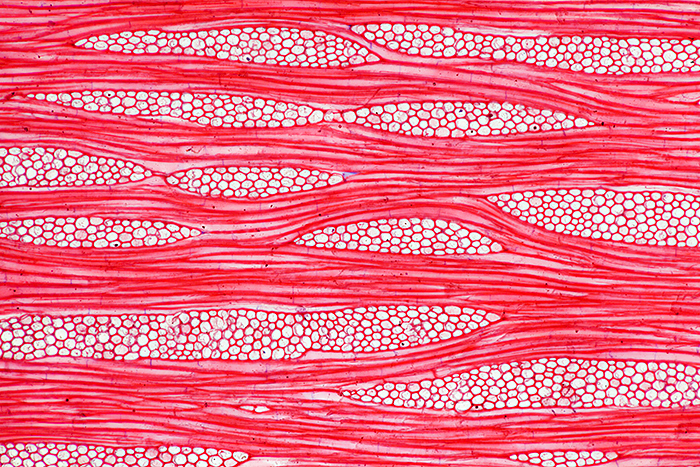 Section of teak (Tectona grandis) stained with safranin
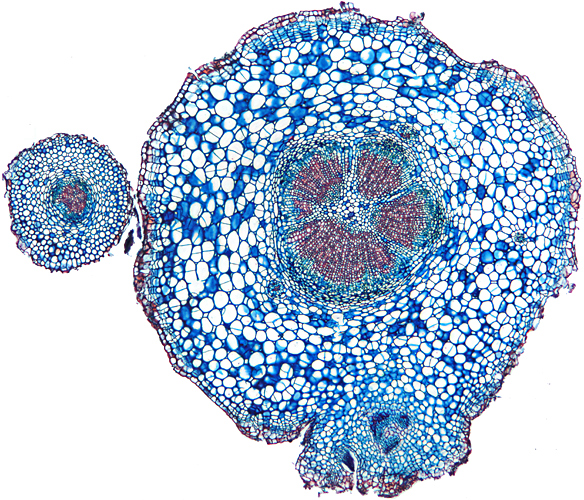 Transverse section of root of daisy (Bellis perennis)
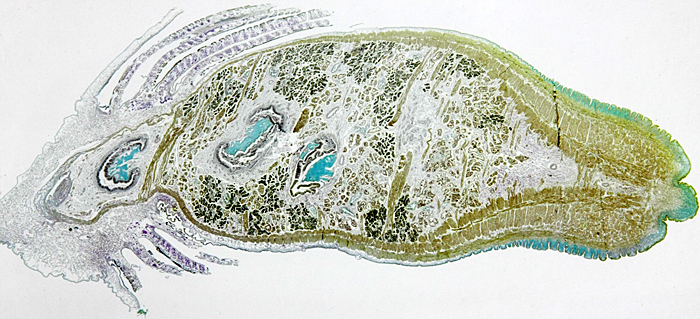 Transverse section of swan mussel
 Longitudinal section of rabbit embryo
 Pam Hamer, Mark Papp, Joan Bingley and Chris Thomas
 Terry Hope
 Jacky McPherson and Graham Matthews
 Phil Greaves and Nigel Williams
After the gossip, we walked along the corridor to the Neil Chalmers Seminar Room for Terry Hope’s second presidential address “The Gain In Brain Lies Mainly In The Stain”.
 Terry Hope lecturing
Quekett members can watch a video of the lecture.
Report and most photographs by Alan Wood