

Gossip meeting “Rocks, minerals and microscopes”
Saturday 7th June 2025
When we set up a Club display at the annual Geologists’ Association Festival of Geology in November 2024, we met a variety of people who are interested in microscopical techniques. This informal gossip meeting, held in the East Hagbourne Sports Pavilion, was a chance for the members interested in this topic to meet up and display some of their equipment. There were ten enthusiasts on the day.
A small contingent from the Bath GA group were led by Sam Medworth. He, and Jonathan Slack, are interested in preparing and examining thin sections and they brought microscopes, slides and related hand specimens illustrating their work. Philip Costa is a very enthusiastic recently joined member of the Club who wants to do more microscopy on his collection of stones and pebbles stored very impressively in a garden structure. He brought a stereo microscope to show some specimens. Nigel Parkinson admitted that he was not examining geological items but collects microscopes including a couple of interesting ones he brought to display. He had a historical series showing the development of petrological microscopes by the British firm James Swift, from early brass types with Nicol prisms through to later 20th century ones using Polaroid. Of particular interest was a Swift polarising microscope with the Dick modification, a device linking the polariser and analyser so these could be rotated with respect to a specimen mounted on the stationary stage. Frank Leaver brought a modest item, a brass plate with a central aperture for replaceable selenite filters. He had investigated this and found details in an early microscopical publication. Chris Kennedy displayed several brass polarising microscopes showing the development of this type of microscope through the years, starting with Nicol prism polarisers. These were much admired. Owen Green had a Nikon polarising microscope and had brought some rock peels to display. There was also an Automatic Point Counter, a clockwork gadget that moves the slide across the stage in fixed steps to enable statistical sampling of the mineral found under the cross hairs. This is now much easier to do on a digital photograph! Pam Hamer is investigating a donation to the Club of geological slides and was showing them on a Vickers polarising microscope and with a Dinolite polarising digital microscope. Some of the slides were declared of excellent quality by Sam’s colleague, though he questioned the identification of the rock type on some slides. Some of the slides had obviously been prepared many years ago and rock identifications have been refined.
The venue does not have AV facilities but we were able to gather around a monitor screen as Owen used one of the presentations given to his Oxford students to promote a discussion on the selection of rocks for thin section work and the process of preparing them. Ideas on mountants and polishing procedures were discussed. In the afternoon we had a similar general discussion about Michel-Levy charts. How to use them and, equally important, looking at the variation in the colour reproduction of charts from a variety of sources. Owen was particularly keen on one produced by the University of Liverpool which showed both the colours produced using crossed polars alongside the complementary colours produced by parallel polars. Using the latter helps to identify the order of the colours on the chart. This led to thoughts about the identification of colours using the charts with LED illumination sources.
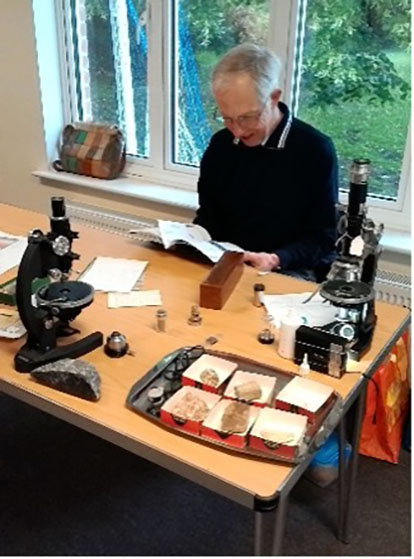
Sam Medworth with his display of slides and hand specimens, and his Cooke, Troughton & Simms polarising microscope
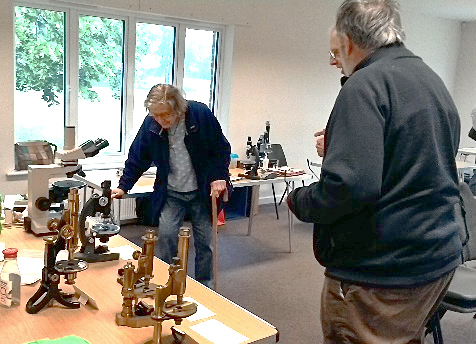 Chris Kennedy (right) and some of the microscopes brought by him and Owen Green
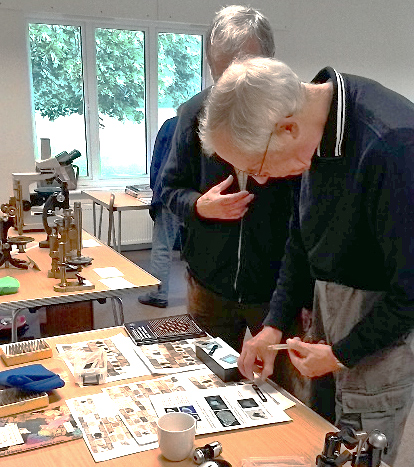 Sam Medworth examining some of the slides donated to the Club from Birkbeck College
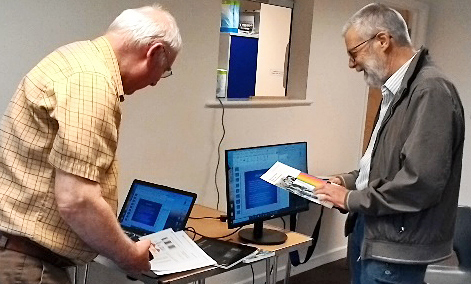 Owen Green and Frank Leaver examining the different reproductions of Michel-Levy charts