

AES Members’ Day
Saturday 6th June 2026
As a contribution to the Club’s microscopy outreach programme, Pam Hamer, Laurence Peacock and Alan Wood took along an assortment of specimens, slides and microscopes to the 2026 Members’ Day and AGM of the Amateur Entomologists’ Society (AES), held this year in the Neil Chalmers Seminar Room at the Natural History Museum in London.
Our display was set out in the foyer, so everyone attending the AGM and the lectures had to walk past us. The AES also had a table in the foyer, with their publications for adults and for children.
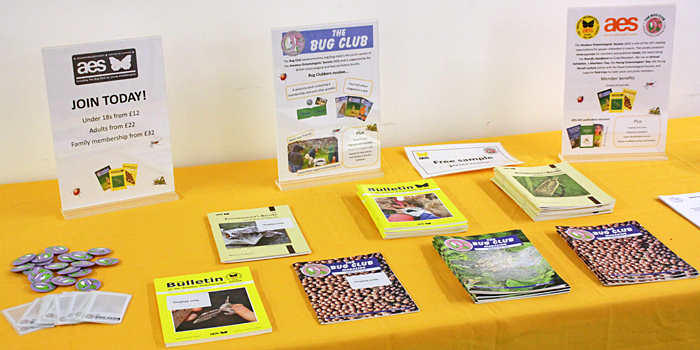 AES display
They also provided a generous selection of hot and cold drinks, biscuits and crisps.
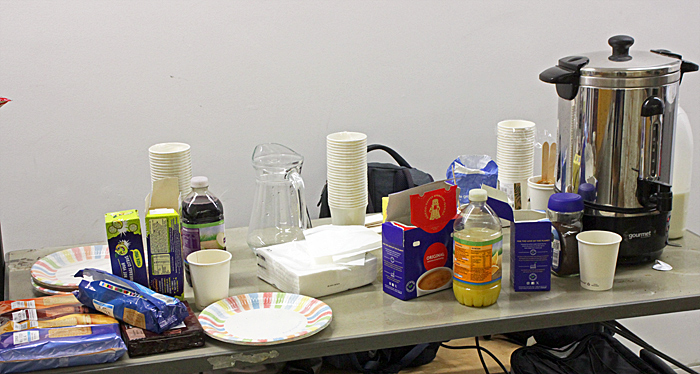 Refreshments
Pam Hamer brought a small digital microscope with a built-in screen, a binocular Lomo compound microscope, slides of honeybee parts and pollen, and lots of leaflets. For the Lomo, Pam used a variable LED illuminator placed below the condenser, running from a powerbank.
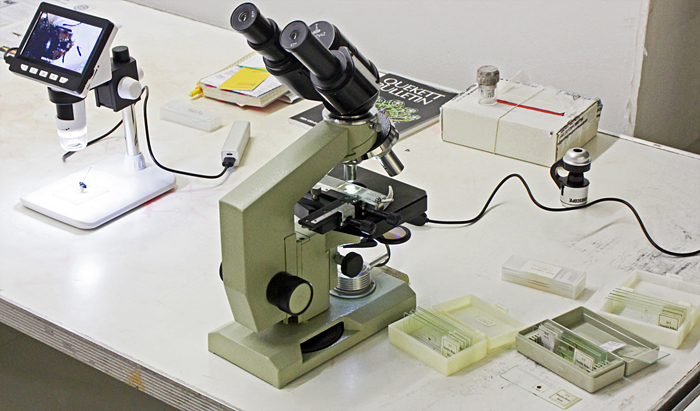 Compound and digital microscopes
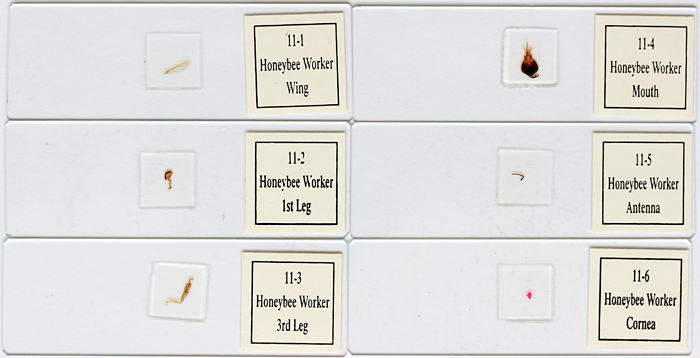 Honeybee slides from Brunel
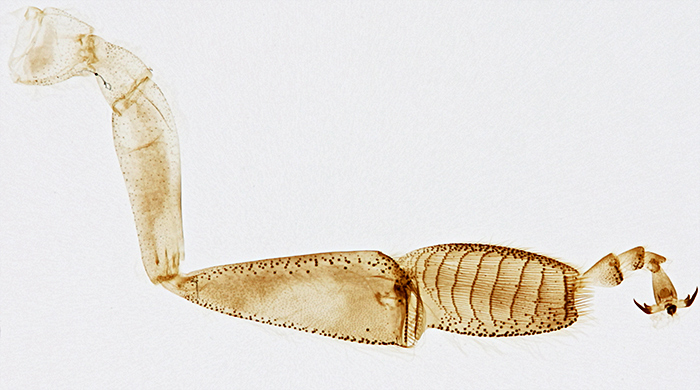 Third leg of worker honeybee (with pollen basket)
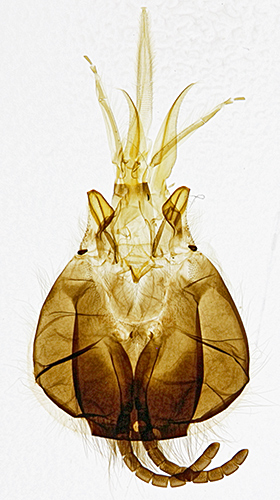 Head of honeybee
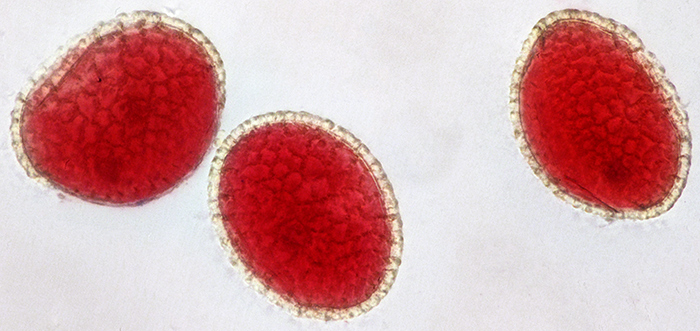 Stained lily pollen grains (lengths 80, 83 and 90 µm)
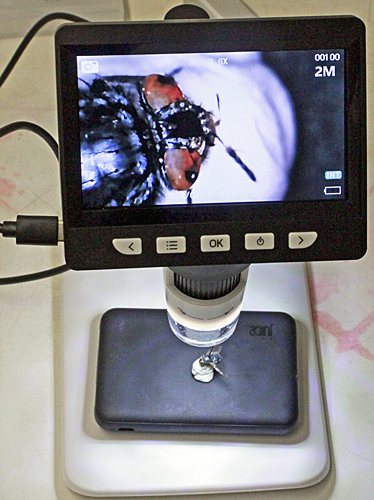 Digital microscope (showing the head of a fly)
Pam demonstrated that you can photograph slides with an adapter that clips on to a smartphone.
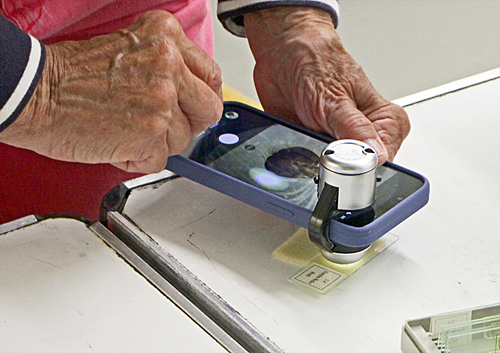 Photographing slide with smartphone adapter
The Quekett produces lots of leaflets that are given away at events and are also available as free downloadable PDFs.
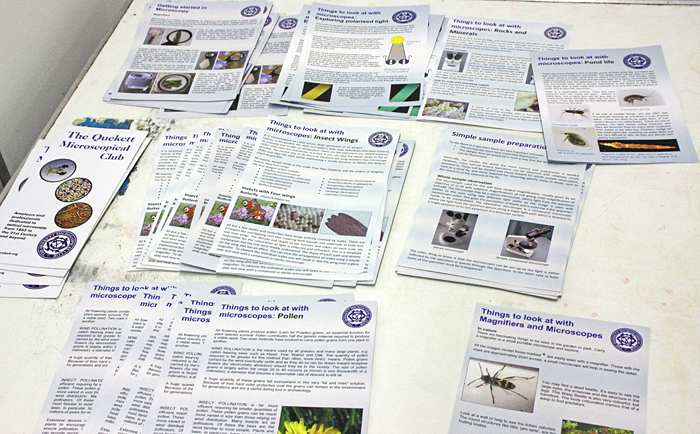 Quekett leaflets
Alan Wood brought his Olympus trinocular SZ4045 stereo microscope, some set insect specimens and some slides and photographs of insects. Instead of the microscope’s original dim and hot tungsten illuminator, he uses an LED ring-light that is bright and stays cool all day. He demonstrated taking photographs through the microscope with a Canon EOS full-frame digital camera tethered to a laptop with the free EOS Utility software.
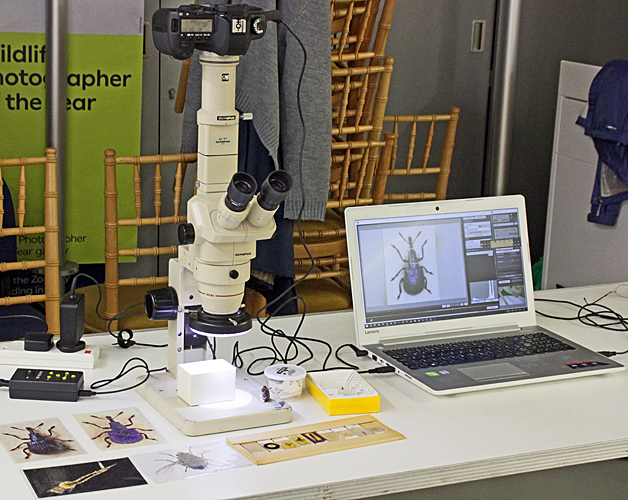 Stereo microscope with digital camera
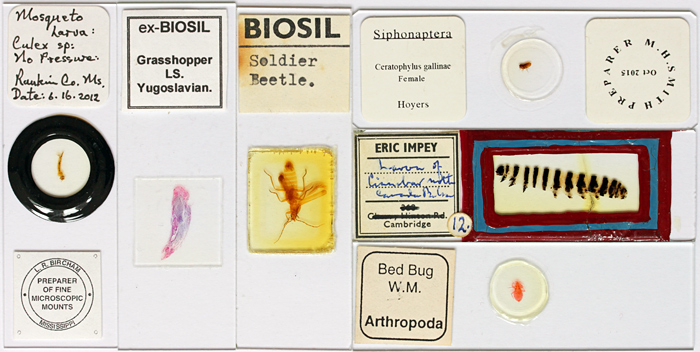 Insect slides
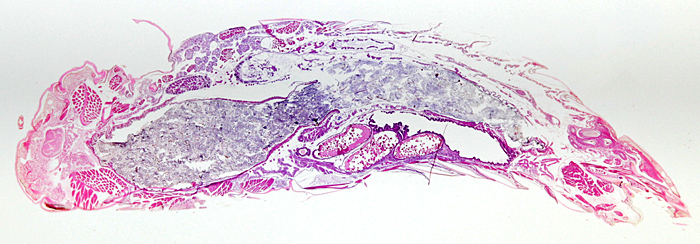 Stained section of grasshopper
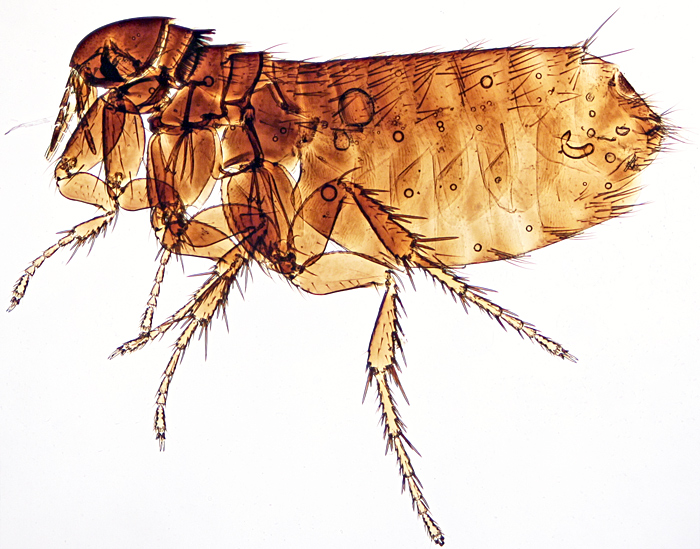 Female European chicken flea (Ceratophyllus gallinae)
 Larva of a mosquito (Culex pipiens) – dark-ground illumination
Alan also brought some set specimens, including a moth (? Thysanoplusia orichalcea) from Indonesia, a fly (Calliphora vomitoria) and a small iridescent beetle (? Rhynchites caeruleus)
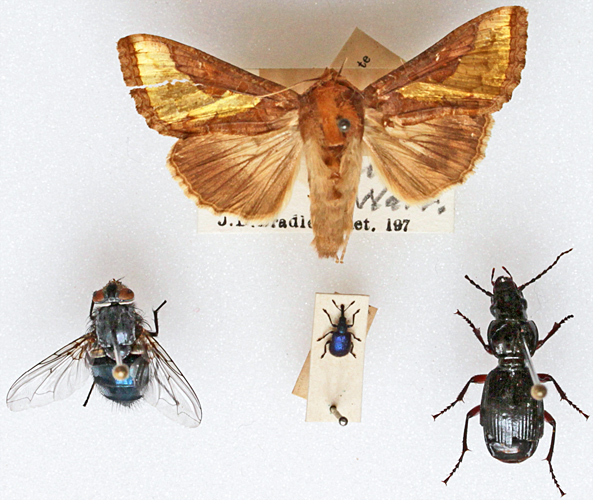 Insect specimens
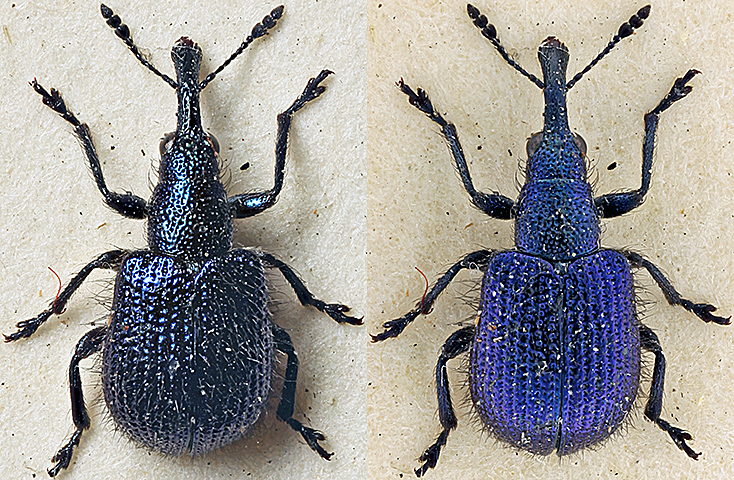 Small iridescent beetle (? Rhynchitidae) lit by desk lamps and by shadowless illuminator
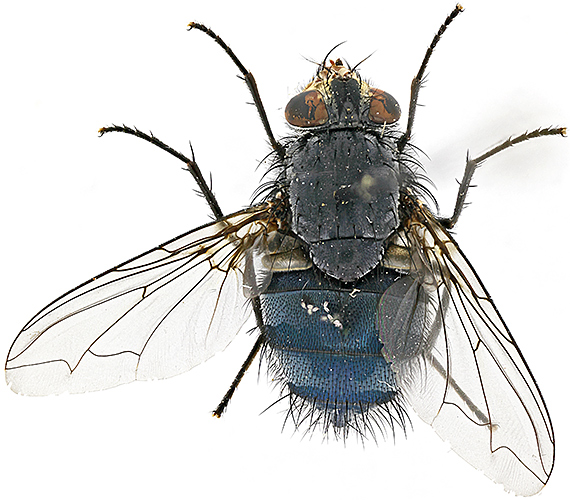 Blue bottle (Calliphora vomitoria) using shadowless illuminator
One AES member brought some eggs and newly-hatched larvae of the Atlas moth (Attacus atlas), and we displayed them on Alan’s laptop (via the stereo microscope).
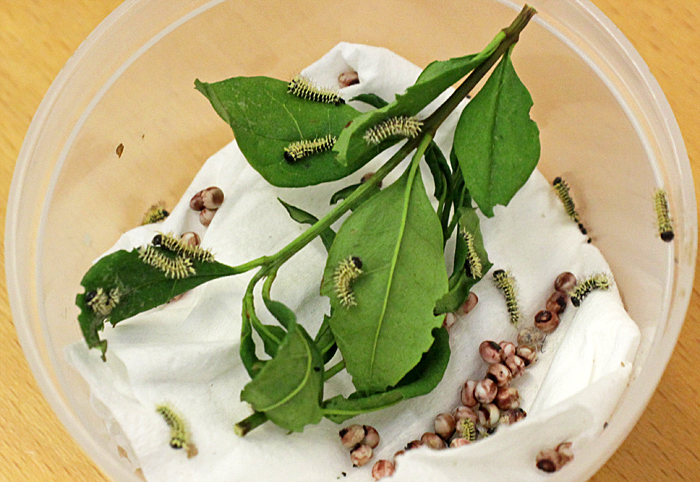 Atlas moth eggs and caterpillars
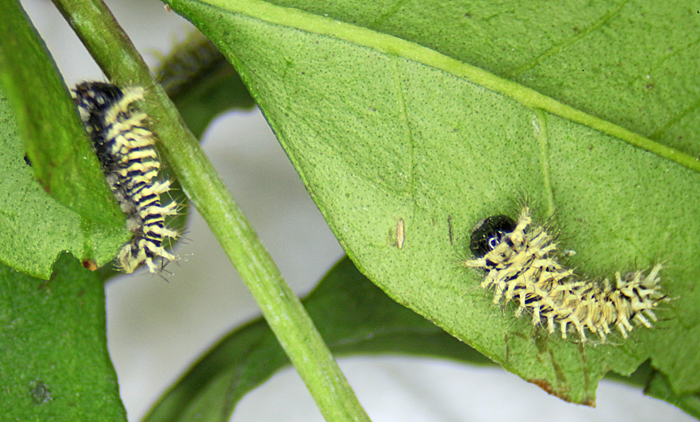 Atlas moth caterpillars under the stereo microscope
Another AES member brought a dead cockchafer (Melolontha melolontha), and we examined its folded antennae on the digital microscope and the stereo microscope.
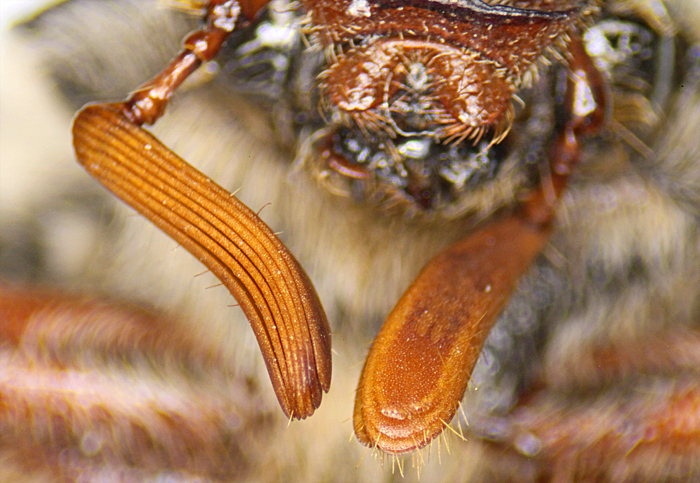 Cockchafer antennae
Some of the AES members and passing NHM volunteers were keen to use the microscopes to examine slides and specimens.
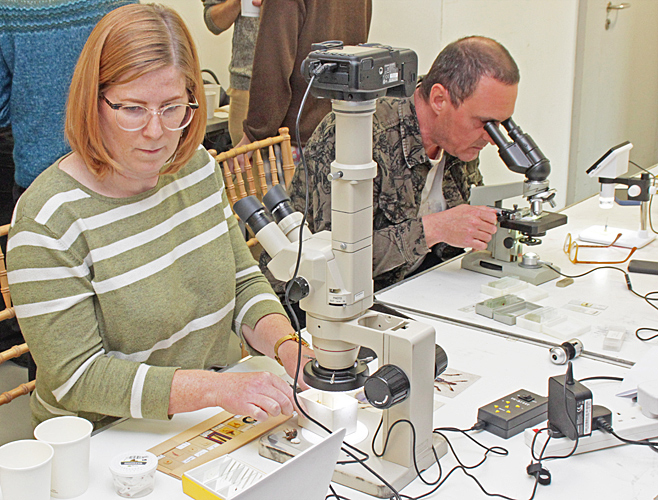 AES members with microscopes
We had some interesting discussions with entomologists and beekeepers, explaining our backgrounds and our interests in microscopy. Laurence used his tablet to show videos and photos of pond life. Alan connected his laptop to the Museum’s free WiFi to show pages from his blog.
Some people asked about equipment for taking photographs through a microscope. Alan purchased his equipment several years ago, and now there is cheaper equipment available. Most trinocular stereo and compound microscopes now come with a fitting for a C-mount camera, and suitable digital cameras start at around £150. Digital cameras that replace an eyepiece are less convenient but can be cheaper. Smartphones held just above an eyepiece, either by hand or with an adapter, can also produce surprisingly good results.
 Smartphone photomicrography at a Quekett workshop
Some wanted to know where to buy new microscopes, and we recommended Brunel Microscopes and GT Vision. Brunel also sell used microscopes. Used microscopes (and accessories, slides, books, etcetera) are also available at microscope club meetings, including the annual Quekett events in Letchworth Garden City and Sonning Common (near Reading). eBay also has lots of new and used items for sale, but it can be difficult to tell if an item is complete and in working order.
Alan also used his laptop computer to show PowerPoint presentations of slides and photomicrographs taken by Quekett members.
Slide show: Honeybee anatomy, parasites and pollen
Click the arrows to move through the slides. Click the symbol at bottom right for a larger version.
Click the arrows to move through the slides. Click the symbol at bottom right for a larger version.
Alan also showed a PowerPoint that explains how to use an LED ring-light to produce shadowless and dark-ground illumination:
Click the arrows to move through the slides. Click the symbol at bottom right for a larger version.
There were several interesting talks in the afternoon:
- Nick Cooke: Pearl-bordered Fritillary in the Trossachs – rediscovery and conservation
- Charles Barker (Hammond Award winner): Ground Beetle sampling for Red-backed Shrike reintroduction sites in Sussex
- Inez Januszczak (NHM): Insects and genomics; the Darwin Tree of Life project
- Joss Carr: The entoLive project
- Jacqui James (Cambridge): Conserving the Shrill Carder bee: investigating the effects of habitat restoration in south Somerset
- Leonard Tesch lecture: Dr Tim King (Oxford): The underground influence of yellow meadow ants on all the other animals in old grasslands
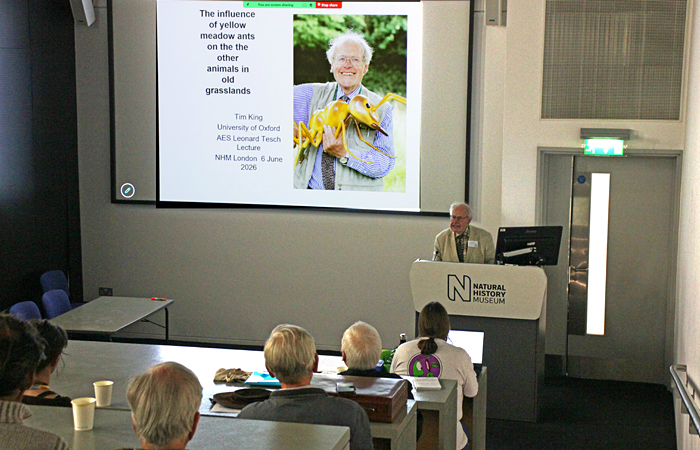 Tom King lecturing
Report and photographs by Alan Wood