

Broadstone Library Microscope Display
Wednesday 28th October 2026
Despite the rare appearance of sunshine after days of stormy weather, local parents and families arrived in force at Broadstone Library over the Wednesday half term. The library staff were very welcoming and organised in setting up the display tables before our arrival, for a short 2-hour drop-in session from the Quekett Microscopical Club and the Bournemouth Natural Science Society (BNSS).
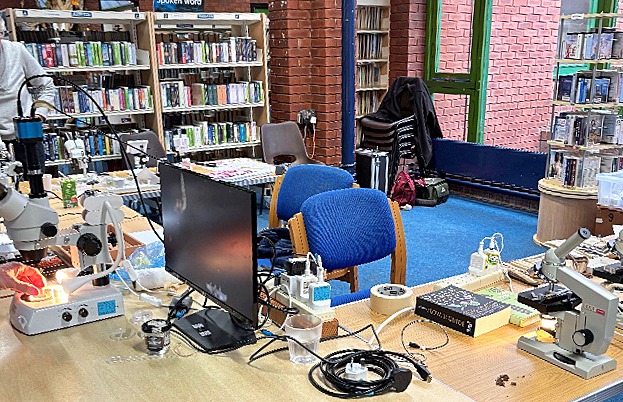 General view
Thanks to the very well-prepared advertising campaign on the part of library staff, we had one of the busiest microscope sessions at Poole to date. All four of us were talking non-stop over the time we spent showing visitors ways to use a range of microscopes.
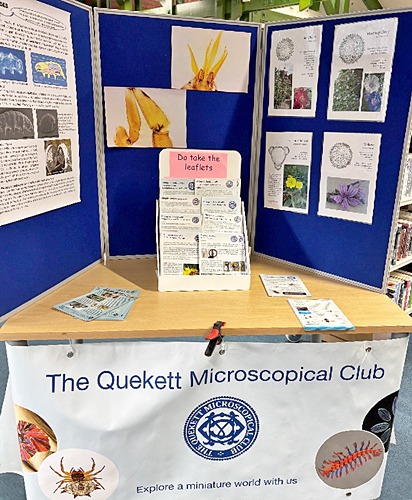 Quekett display
Pam Hamer set up a detailed and interesting display of bees and pollen. The eyes of the hornet under the binocular microscope looked particularly intimidating. There were also a variety of flower heads and slides showing how pollen was trapped into bee pollen baskets and carried back to the hive. This was enhanced further with a poster presentation of pollen on the display boards provided together with a pollen quiz for the more adventurous visitors. Children had the opportunity to mount pollen grains onto a plastic slide sealed with sticky tape to see the pollen grain structure and with the added benefit of taking their preparation home to keep.
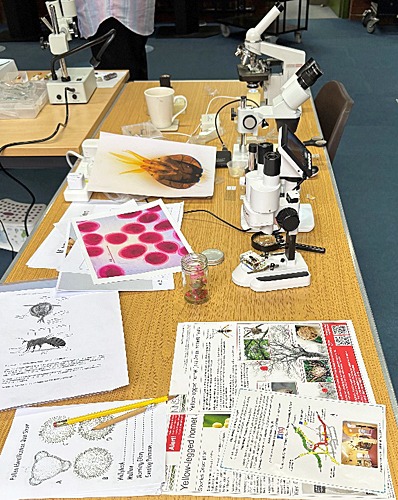 Pam Hamer’s display
Jacque Bainbridge brought three stereo microscopes (a Brunel ×20, a long-arm Brunel, and a Swift stereo microscope). Binocular microscopes illuminating a variety of quartz, amethyst, pyrites, gemstones, a range of insects, and spiders could be viewed under closer scrutiny. As always, the most popular specimens were the sparkly specimens and amber samples where entrapped insects could be discovered. Jacque’s thoughtful planning of her display included steps to prop up the younger visitors.
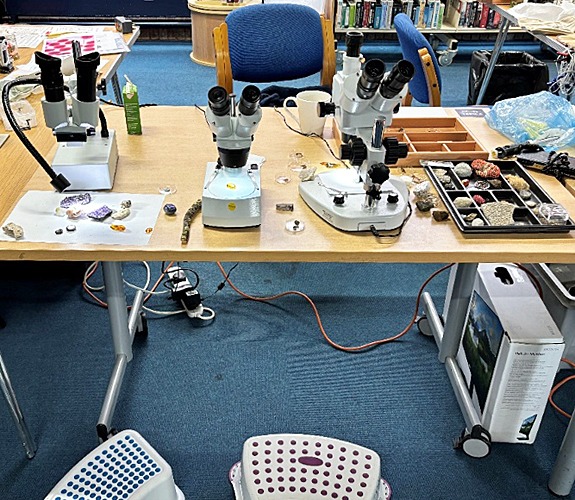 Jacque Bainbridge’s display
Grenham Ireland arrived with an impressive stereo microscope connected to a monitor to show samples of tardigrades and nematodes collected from moss samples. Active tardigrades were illuminated obliquely against a dark background on the dissection microscope and shown magnified about 150 times on the monitor using an attached 14 MP Chinese inspection camera with HDMI output. I was so impressed that the heavy equipment that took some time to set up was Grenham’s idea of “travelling light” because there was limited display space to make use of.
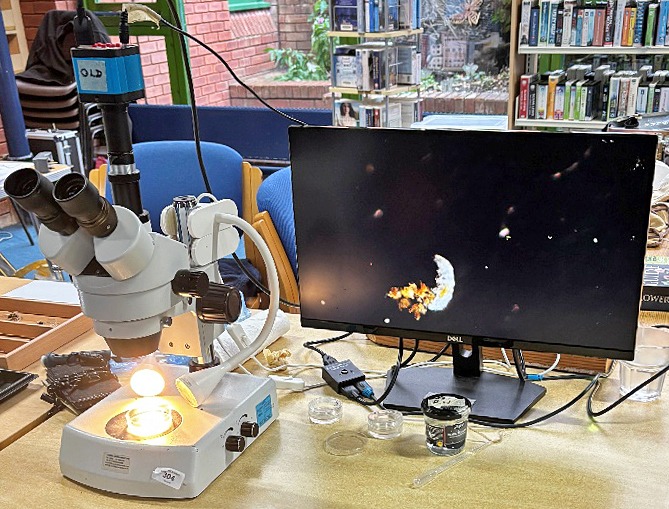 Grenham Ireland’s display
Debbie Burfitt borrowed two Lomo compound microscopes from the museum at Bournemouth. A variety of seaweeds, plants and mosses were brought in for inspection. Hand lenses were provided to observe the distinguishing features of Ling and Bell heather. Pine cones were available to dissect to search for seeds and wing cases. Mosses and algae were used to make temporary mounts with slides and coverslips. The children asked why the optics of the Lomo microscopes were so much better than their light microscopes at home. The fine focusing dial at the base of the microscope caused intrigue due to its differing design. There were a couple of requests asking if the Quekett ran microscope sales of second-hand microscopes to purchase.
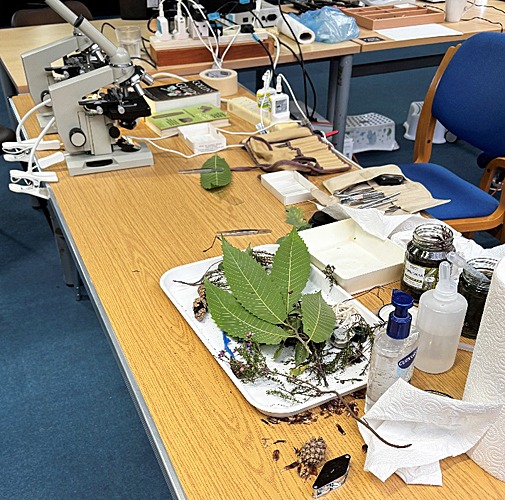 Debbie Burfitt’s display
Both parents and children alike were interested by the interactive displays on offer. The highlight of my day was at the very end when we were half an hour overdue to pack up a young visitor came up to me to ask about more details about the Quekett Microscopical Club and the Museum, as she would like to join! She wanted to find out more and could she get a leaflet with the information. It left me with the very satisfied feeling that we had managed to have a very successful day.
Debbie Burfitt